 Qrop
QropQR codes for small business: a plan for every size
By Qrop Team ·
Somewhere on Qrop's infrastructure right now, a home baker is generating a QR code for their market-stall Wi-Fi, and a fast-growing platform is calling the API a few thousand times a minute to stamp a unique code on every order. Same generator, same error-correction math, same contrast checks before anything ships. The only thing that changes between them is which door they came in through, and that's exactly why QR codes for small business and QR codes for scaling platforms end up being the same product wearing different plans.
That's the point worth making explicit: nothing about Qrop is built for one size of business and merely tolerant of the rest. Every tier, free included, is a real product decision, not a stripped-down teaser for the paid plans. This walks through what's actually on offer, who each rung of the ladder is genuinely built for, and how to tell which one fits you today (with the honest caveat that "today" is allowed to change).
The Qrop ladder: built for small business, not just built to scale
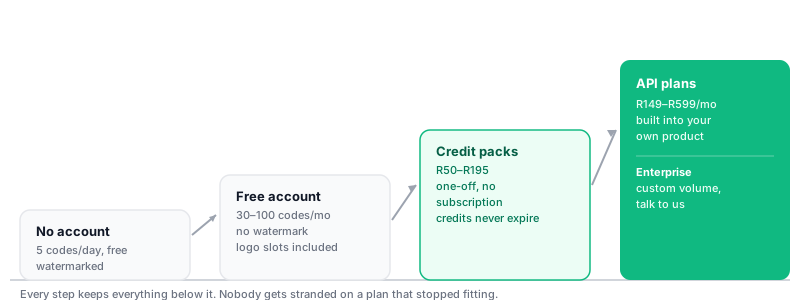
There are, in effect, four doors into Qrop, and they stack rather than replace each other. Nothing here is a bait-and-switch free trial: the free tiers stay free indefinitely, and moving up a rung only ever adds capability.
- No account at all: 5 QR codes a day, capped at 512px, with a small watermark in the logo slot. Genuinely useful for a one-off, no signup, no card required.
- A free registered account: 30 generations a month on a personal account or 100 on a company account, no watermark, output up to 2048px, plus a small monthly allowance of free logo-branded codes.
- Credit packs: a one-off purchase (250 credits for R50, up to 1,500 for R195) for whenever the free monthly allowance runs out. No subscription, credits never expire.
- API plans: R149 to R599 a month for businesses generating codes programmatically at volume, with a custom Enterprise tier above that for anyone bigger than the largest published plan.
The home bakery: free, and genuinely free
Picture a home bakery doing three farmers' markets a month. The whole QR need is a handful of codes: Wi-Fi for the card machine, a vCard so customers can save the number for custom orders, maybe a code linking to an Instagram page taped to the front of the stall.
That's the free registered tier, doing exactly its job. Thirty generations a month is not a rounding error for a business at this scale, it's headroom that will rarely get touched. No watermark, no card details on file, no clock ticking anywhere. The anonymous tier (no account, no signup) covers even the one-off case: printing a single Wi-Fi code before a single market and never needing another one.
This is worth sitting with for a second: a lot of tools call this tier a "free trial" and mean "free until we email you about upgrading." Qrop's free tier isn't a funnel, it's a genuinely sized allowance for a genuinely small workload. If a business stays at this size forever, so does the free plan.
The boutique retailer: credit packs without a subscription
Now scale up: a boutique selling maybe 400 items a month online and in-store, wanting a branded, logo-embedded QR code on every product tag linking to a care guide or a restock page. That's past the free logo allowance most months, but nowhere near needing an API integration.
This is exactly what credit packs are for. No recurring charge, no plan to manage, just a top-up when the free allowance runs dry. Buy the 750-credit pack for R115 and that's roughly R0.15 a code, more than enough for a busy month of new tags, seasonal restocks, and a run of gift cards, and whatever's left over rolls into next month because credits don't expire.
The retailer never has to think about "upgrading" in the subscription sense. They buy more credits exactly when they need them and never again if a slow month means they don't.
The growing SaaS: the API without the enterprise overhead
Different shape of business entirely: a SaaS platform that needs to generate a unique QR code for every customer order, ticket, or asset tag, programmatically, on demand, as part of its own product. This is where the web generator stops being the right tool and the API starts being the only tool.
The Starter plan (R149/month, 3,000 included credits) covers a platform doing a few thousand codes a month comfortably, with room to spare. Pro (R299/month, 9,000 credits, and roughly triple the request-per-second ceiling of Starter) is the natural next step once volume, or the need to batch requests in parallel, outgrows Starter's limits. Unused included credits roll forward between periods too, so a quiet month doesn't waste what was already paid for.
Nothing about this tier requires being a big company. It requires having a product that needs QR generation baked in as infrastructure rather than fetched from a web page, which is a workflow shape, not a headcount.
The high-volume platform: Growth, Enterprise, and knowing when to ask
At the top of the ladder sits genuine scale: a logistics platform tagging every parcel, a ticketing system issuing codes by the tens of thousands for a single event, a marketplace stamping a unique code on every listing. The Growth plan (R599/month, 20,000 included credits) exists specifically to close the gap between Pro and a bespoke deal, and Enterprise, custom volume, custom limits, is the option once even Growth's ceiling isn't the right shape for the workload.
The overage rate (what you pay per credit beyond your plan's included allocation) is identical across every paid tier. That's a deliberate choice: moving up a plan is purely about buying headroom and higher rate limits, never about dodging a penalty for staying on a smaller plan. Nobody gets punished for guessing their volume slightly wrong.
Businesses at this scale are also the ones most likely to want the tracking feature landing on Qrop soon, turning a static code into a redirect that logs every scan, groups codes into campaigns, and lets a destination change without reprinting a single label. Worth knowing about now even if it's not live yet.
Which business are you? A quick fit-check
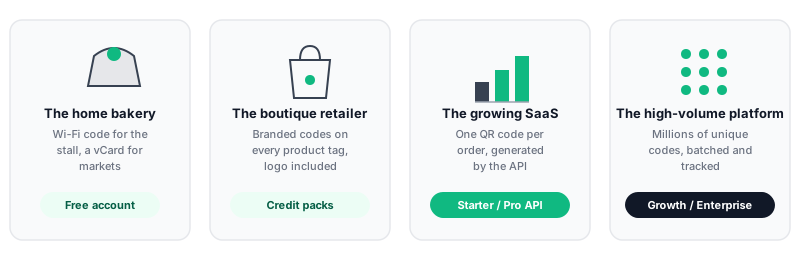
A rough but honest way to self-sort: if you're printing codes by hand for physical materials (menus, stalls, product tags, business cards) and generating fewer than a few dozen a month, you're on the free tier and probably should stay there. Cross into hundreds a month, still through the web interface, and a credit pack is the cheaper, calmer option over constantly re-registering or juggling multiple accounts.
The moment code generation needs to happen without a human clicking a button (triggered by an order, a signup, a shipment) that's the signal to move to the API, starting wherever Starter or Pro actually covers your volume. And if the volume is measured in tens of thousands a month or the request-rate limits on Growth start to feel tight, that's the point to reach out directly rather than guessing at a plan.
None of this is a one-way ratchet, either. A quiet season on an API plan means unused credits carry forward rather than vanish, and cancelling or downgrading takes effect at the end of the period you've already paid for, never mid-cycle.
Frequently asked questions
Do I need to pay anything to start using Qrop?
No. Anonymous visitors get 5 free generations a day with no signup, and a free registered account raises that to 30 a month personally or 100 for a company account, with no watermark. Most very small businesses never need to leave the free tier.
What if my business is too small to need an API?
Then you probably don't need one, and that's fine. The web generator and credit packs cover the vast majority of small-business use cases: menus, product tags, business cards, Wi-Fi codes, and marketing materials. The API exists for programmatic generation triggered by your own product, not as a more "serious" version of the same task.
Can I add my logo to a QR code without paying?
Yes, up to a monthly allowance. Free registered accounts get 5 logo-embedded generations a month on a personal account or 20 on a company account. Beyond that allowance, a logo costs 2 credits from a purchased balance rather than a free generation.
What happens if my business outgrows its current plan?
You move up a rung, and nothing below it disappears. A free account that starts buying credit packs keeps its free monthly allowance. A credit-pack user who moves to the API keeps any unused purchased credits as a buffer before overage kicks in. Nothing is locked away or forfeited when volume grows.
Is there a plan for very high-volume businesses?
Yes. The Growth plan covers 20,000 included credits a month, and Enterprise is available above that with custom included credits and rate limits for businesses whose volume doesn't fit any published tier. Reach out directly to discuss requirements at that scale.
Related guides
Ready to create your QR code?
Generate a free QR code in seconds: custom colours, logos, and PNG, SVG or PDF output.
Open the generator